Showing posts with label James Boswell. Show all posts

Monday, 22 December 2008

Boswell: King of the Rakes


Well, I confess I'm really surprised by the rake votes - not a single vote for Casanova, and a tie-breaker between Boswell and the Earl of Rochester! Well, after much deliberation, I've decided to crown Boswell as favourite rake, if only because his cosy image as Dr Johnson's biographer needs challenging.

He was born in 1740, the son of a judge, Alexander Boswell, 8th Laird of Auchinleck and his wife Euphemia Erskine. His early years were characterised by a clash between profligate tendencies and and a powerful sense of duty to his father, who wanted him to study law. Following an unrequited passion for an actress, Mrs Cowper, he hit upon the idea of going to London to become a Roman Catholic priest (the piousness of Mrs Cowper no doubt inspired this). He rode non-stop for two and a half days in order to reach the capital, and when there, abandoned his religious intentions almost immediately in favour of 'the melting and transporting rites of love' at the Blue Perriwig in Holborn.

Back in Scotland, Boswell embarked on various dalliances, one of which - with his maidservant Peggy Doig - resulted in the birth of the first of his illegitimate children. Meanwhile, virtually any woman in the vicinity took his fancy: 'At supper I fell much in love with the chambermaid who served us who was a handsome girl with an insinuating wantonness of look,' he drooled.


Returning to London in 1762, his London Journal includes many accounts of his exploits, a typical diary entry being as follows:
I should have mentioned last night that I met with a monstrous big whore in the Strand... I went into a tavern with her, where she displayed to me all the parts of her enormous carcass; but I found that her avarice was as large as her a---, for she would by no means take what I offered her... I was so much in the lewd humour that I felt myself restless, and took a little girl into a court; but wanted vigour. So I went home, resolved against low street debauchery.
Much of this seems surprising when you consider Boswell's friendship with Johnson: a pious man who took a dim view of indulgences of any kind; in Boswell's Life of Johnson he records an exchange with the writer on the subject of prostitution, in which Johnson remarks: 'Sir, it is very absurd to argue, as has been often done, that prostitutes are necessary to prevent the violent effects of appetite from violating the decent order of life; nay, should be permitted, in order to preserve the chastity of our wives and daughters. Depend upon it, Sir, severe laws, steadily enforced, would be sufficient against those evils, and would promote marriage.'

As Julie Peakman observes in Lascivious Bodies (to which I'm indebted for this article), Boswell was a man of inconstant moods, who burned with passion one moment and dropped a woman the next. He later settled down with his cousin, Margaret Montgomerie, who bore him seven children, yet like most 18th-century libertines, though he loved 'that valuable woman', he continued his dalliances for the rest of his life.

Thank you all for voting!

 Subscribe now!

Sunday, 14 December 2008

Giddy libertines and drunken ravishers

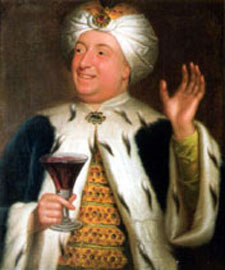
I'm aware that I haven't exactly depicted these rakes in a romantic light, but if one man's outrageous behaviour has particularly amused you, then please vote for him on the right-hand sidebar and/or post some comments - I'd love to hear what you think! And check back for info on the rakes' progress - I'll post an article on the winning libertine in due course.

Sir Francis Dashwood (1708-81)
Rake, profligate and chancellor of the exchequer (1761-3), Dashwood is perhaps best known as the founder of the Hell-Fire Club and the Society of Dilettanti. Horace Walpole described the latter as ‘a club of which the nominal qualification is having been to Italy, and the real one of being drunk’. Dashwood conceived the idea for the Hell-Fire Club while at a service at the Sistine Chapel, during which worshippers pretended to scourge themselves with whips. Unsatisfied with this pretence, he returned later with a horsewhip and thrashed the congregation soundly. He was thrown out of Italy for ‘scandalous behaviour’.

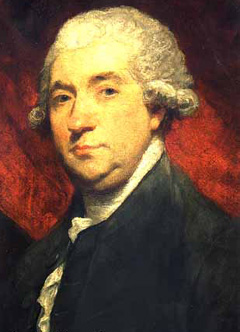
James Boswell (1740-1795)
The diarist and biographer of Johnson had a lecherous eye for the ladies, not to mention a penchant for ‘old hock’ and rude drinking songs. Young, restless and spurned by an actress, he decided to leave Glasgow for London in order to become a Roman Catholic priest. No sooner had he arrived than he was seeking out the ‘melting and transporting rites of love’ courtesy of girls in the Strand. While detailing his philanderings with an actress in his London Journal, he boasted: ‘Proud of my godlike vigour, I soon resumed the noble game… [Louisa] declared I was a prodigy.’ His feelings cooled when he realised she had given him the pox.

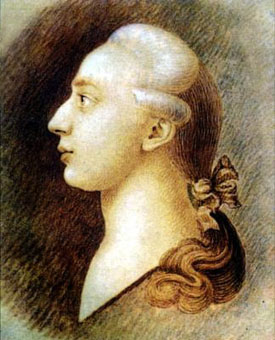
Giacomo Casanova (1725-1798)
Silver-tongued Casanova understood and loved women, though he was not above bribing them: ‘There exists no honest woman with an uncorrupted heart whom a man is not sure of conquering by gratitude,’ he crowed. Favoured with a special dispensation from the Pope to read pornography, he lived a life of quick exits across rooftops and fields, pursued by husbands and debt-collectors. It was all too much for the Venetian Inquisition, which imprisoned him for contempt of religion in 1755, but following a spectacular jail-break, he roamed Europe in pursuit of the ladies, penning his sensational memoir Histoire de ma vie, which was published posthumously.

John Wilmot, 2nd Earl of Rochester (1647-1680)
Wilmot was a renowned poet, wit and friend to King Charles II. At court he became known for drunkenness and ‘extravagant frolics’ as part of a group called the Merry Gang. Obsessed with the theatre, he flirted with actresses and began an affair with the great Restoration actress Elizabeth Barry, though his poems suggest that he was, in fact, bisexual. Having offended the king, he was briefly exiled, and in 1676 compounded matters by causing a scuffle in which a man was killed. He went underground, taking on the persona of a quack physician called Doctor Bendo who - rather suspiciously - specialised in infertility. He died aged 33 of syphilis or alcoholism, or both.

Subscribe now!

Sunday, 7 December 2008

We are a city of philosophers...

Lichfield's famous son, and his biographer, contemplate yesterday's shoppers from their pedestals in the market square. When Boswell (pictured, bottom) remarked on Lichfield's lack of trade, Johnson (top) loftily explained: 'We are a city of philosophers. We work with our heads and make the boobies of Birmingham work for us with our hands.'


 Subscribe now!