Saturday, 13 December 2008

Happy birthday, Erasmus


How remiss of me, I forgot to wish Erasmus Darwin a happy birthday yesterday. Thank goodness that Palaeoblog remembered! Here's a seasonal excerpt from my copy of Darwin's The Loves of the Plants, which, because I'm short on time, I'm going to have to generalise as a botanical poem concerning itself with the sex life of flowers. Yes, really...
Ambitious Visca [mistletoe], from thy eagle-flight! - Scorning the sordid soil, aloft she springs, Shakes her white plume, and claps her golden wings; High o'er the fields of boundless ether roves, and seeks amid the clouds her soaring loves!
Footnote: Viscum. Mistletoe. This plant never grows upon the ground; the foliage is yellow, and the berries milk-white; the berries are so viscous, as to serve for bird-lime; and when they fall, adhere to the branches of the tree, on which the plant grows, and strike root into its bark; or are carried to distant trees by birds.

 Subscribe now!

Friday, 12 December 2008

The Chap


Ah, The Chap magazine. While the country plunges deeper into recession, The Chap goes A4 and expands to 12 pages. Thank goodness! Where else can one obtain glossy articles on Georgian rakes?
From The Chap Manifesto: Society has become sick with some nameless malady of the soul. We have become the playthings of corporations intent on converting our world into a gargantuan shopping precinct... we live in a world where children are huge hooded creatures lurking in the shadows; the local hostelry has been taken over by a large chain that specialises in chilled lager, whose principal function is to aggravate the nervous system... It is time for Chaps and Chapettes from all walks of life to stand up and be counted. But fear not, ye languid and ye plain idle: ours is a revolution based not on getting up early and exerting oneself - but a revolution that can be achieved by a single raised eyebrow over a monocle; the ordering of a glass of port in All Bar One; the wearing of a particularly fetching cardigan upon a visit to one's bookmaker...

 Subscribe now!

Triumphing over smallpox


I was intrigued when I came across this monument to Lady Mary Wortley Montagu in Lichfield Cathedral a few days ago, though puzzled as to its origins, given that she's buried in (I think) Yorkshire. It reads:
Sacred to the Memory of The Right Honorable Lady MARY WORTLEY MONTAGUE, who happily introduced from Turkey into this country the Salutary Art of inoculating the Small-Pox. Convinc'd of its Efficacy she first tried it with Success On her own Children and then recommended the practice of it To her fellow-Citizens. Then by her Example and Advice we have soften'd the Virulence and escaped the danger of this malignant Disease. To perpetuate the Memory of such Benevolence, and express her Gratitude for the benefit she herself has receiv'd from the alleviating Art, this Monument is erected by HENRIETTA INGE relict of THEODORE WILLIAM INGE, Esq.r. and Daughter of Sir JOHN WROTTESLEY Baronet in the Year of OUR LORD MDCCLXXXIX

Happily, Rob Hardy's blog, written during a sabbatical in Warwickshire, answers my questions, provides a neat little biog of Lady Mary, and an overview of the scourge of smallpox in the 18th century.

A small addendum to Hardy's article: Edward Jenner was born in Berkeley, England, on 17 May 1749, and would become a pioneer of smallpox vaccination. The act of deliberately giving people smallpox to create immunity, popularised by Lady Mary Wortley Montagu, became known as variolation. Jenner was variolated at school: he was starved, purged and bled, then locked up in a stable with other artificially infected boys until the disease had run its course! Because variolation was still an imprecise science, the technique was a risky one, and some died from it.

Operating as a country doctor, Jenner soon observed the effects of cowpox, and speculated, correctly, that it could act as a safer protective against smallpox. In his garden he installed what would become known as the Temple of Vaccinia: a small hut with a thatched roof where he vaccinated the local poor.

Subscribe now!

Thursday, 11 December 2008

Fire wrecks David Garrick's villa

I'm in shock. I was going to do you a jolly little blog about my visit to David Garrick's villa at Hampton and his Temple to Shakespeare (which I visited on the Open House London weekend). Anyway, as I was nipping through Technorati for some blogs on the legendary 18th-century actor, I came across the news that the Grade I listed villa (below, as I photographed it in 2006) caught fire in October and was badly damaged. English Heritage described the loss of parts of the building as a tragedy, adding that it was of national importance. There's some BBC video of the incident here.

The Temple is actually across the road on the riverbank - Garrick used to access it via a specially built tunnel - so thankfully, it escaped the flames (I'll do a separate blog posting on the Temple at some point). I feel rather shocked and upset about the damage to what Garrick called his 'pretty place by ye Thames side', mainly because his childhood home here in Lichfield has long since been demolished.


Garrick was actually born at the Angel Inn at Hereford, where his father was on an army recruiting expedition, but the family had a house in Lichfield (his mother, Arabella Clough, was the daughter of one of the cathedral clergy). I actually live just up the street from where Garrick grew up, though the site is now occupied by the registry office, which bears a simple plaque (below).


But what a shame about the Hampton villa! When Johnson attended a fête champêtre on Garrick's lawns, he was supposed to have told his host: 'Ah David, it is the leaving of such places that makes a deathbed so terrible.'

Photographs © Memoirs of the Celebrated Mrs Woffington.

 Subscribe now!

Find your way around early Georgian London

For someone like me, occupied with trying to write historical fiction, an old map is a useful imaginative aid. While including exact street names in your novel is tedious (unless you're James Joyce), there's something helpful about visualizing your hero or heroine's neighbourhood - in my case, London in the 1740s - because it helps to bring their world to life. After all, if something seems vivid to you, it should seem vivid to your readers. Imagine how delighted I was, when poking around in Stanfords caverous map shop in Covent Garden, to find a whole set of maps of London in different periods on CD Rom, including maps and topographical prints from John Strype's 1720 edition of John Stow's Survey of the Cities of London and Westminster. Stow's was the very first written survey of London (published in 1598), and Strype carefully updated and extended it to produce an overview of the capital's antiquities and its topography. This advert appeared in Hatton's New View of London (1708):

In a short time Proposals will be published for Reprinting Mr Stow's large Survey of London improv'd; with very great Additions throughout, and illustrated with about 100 large Copper Cutts, viz. of the City in general, and of several of the Wards thereof: of Westminster, Southwark, and all the Out-Parts of the City as they are now: and several Ornamental Plates of Churches, and other Public Buildings in Folio.

Note: this Work has been long preparing, the Cutts requiring much Time and Great Expences, but they are now all finished, and may be seen at the Undertakers.


For some reason I didn't get a copy of John Rocque's famous map, surveyed between 1735 and 1746 (maybe it wasn't on the shelf), but happily, copyright owner Motco Enterprises Ltd. has now put some of it online. It's worth buying the CD of Strype's Stow for the gorgeous topographical prints though - I'm using the beautiful architectural drawing of the south side of St Paul's Cathedral as my desktop image.

 Subscribe now!

Wednesday, 10 December 2008

Minster Pool

Minster pool at dusk today, as I was coming back from Christmas shopping.


 Subscribe now!

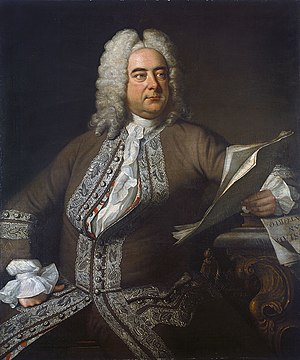
Handel... in the nude

It's funny what you stumble across on research trips. Here are a couple of pictures from a trip I did to Dublin. We paid a visit to Fishamble Street because I wanted to see the site of Neal's Musick-hall, where Handel's Messiah was premiered in April 1742, and we did actually find the remains of the doorway (below), which stands alongside what's now the Handel Hotel.


But as we were inspecting the gate, we caught sight of something in the courtyard beyond. A sculpture of Handel, perched on some organ pipes with his, er, kit off. Now, I don't know about you but I don't remember the maestro appearing in public without his wig, let alone his clothes, and he certainly wasn't that athletic. And if we're going to get all technical, he probably wouldn't even have conducted with a baton. But hey, that's the least of our worries.


I'd love to know who sculpted it, or what indeed Herr Handel would have made of it. I don't think he was known for his sense of humour!


 Subscribe now!